
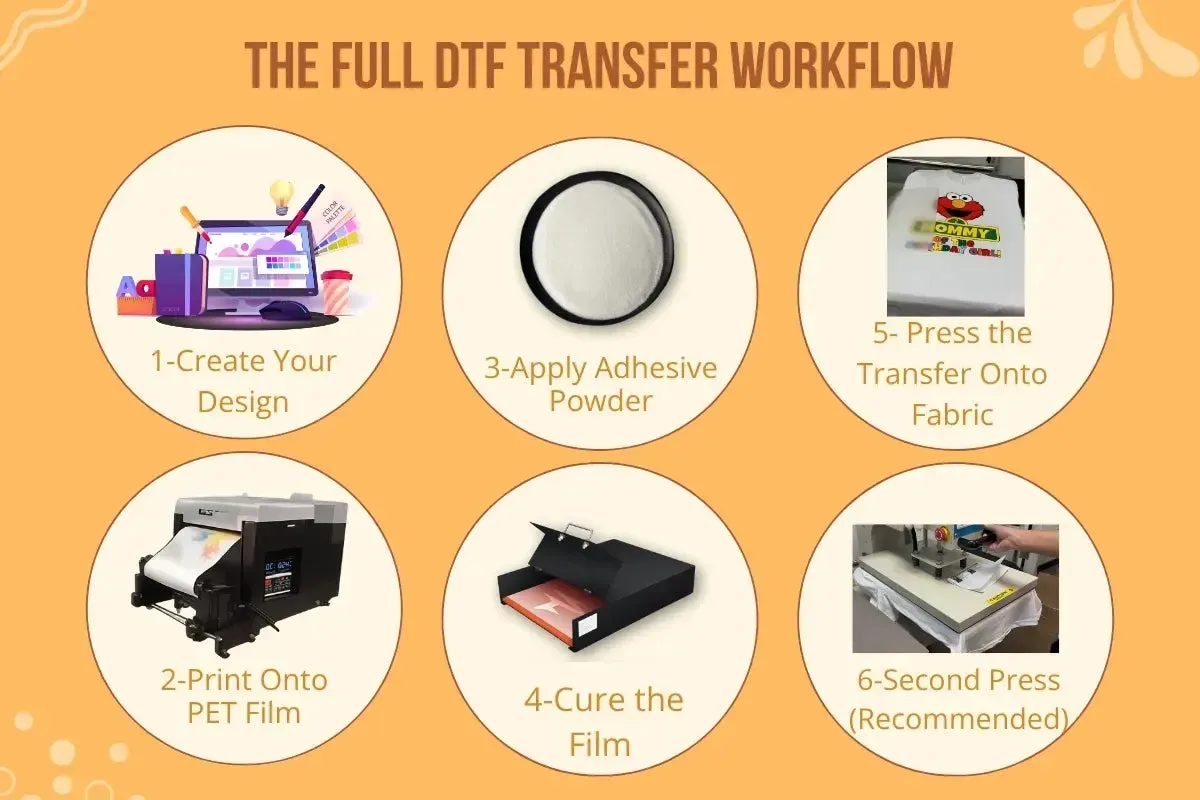
DTF printing workflow has revolutionized on-demand apparel and merchandise production with its flexibility and quality. By streamlining this workflow, you reduce errors, shorten lead times, and deliver consistent results across orders. This guide outlines a practical setup from DTF printer setup and film handling to finishing, emphasizing reliable color management for DTF. Key topics include achieving vibrant transfers, maintaining print consistency, and applying heat press tips to suit different fabrics. Optimizing the workflow also means documenting SOPs, investing in training, and leveraging a strong color-management plan to ensure repeatable, market-ready DTF transfer results.
Viewed through a broader lens, this process is a direct-to-film textile workflow that turns digital artwork into durable fabric decorations. From selecting the right film stock and adhesive to mastering curing and pressing, the steps form a cohesive print-to-fabric pipeline. In LS I terms, industry pros might call it a film-based transfer system, a textile-decoration workflow, or a garment-decoration process—all pointing to the same production sequence.
DTF printing workflow: planning, setup, and scalable production
Effective planning begins by defining clear goals for your DTF printing workflow. Decide whether you aim for high-volume runs, rapid turnarounds, or specialty designs with complex colors, and align printer selection, film type, adhesive powders, and curing times to those goals. Document expected color outcomes and create SOPs that guide planning, file preparation, and production steps to reduce errors and bottlenecks in the transfer process.
Prepare a materials kit and a small buffer stock of common colors and sizes so production isn’t interrupted by stockouts. Build a consistent file preparation standard—resolution, color profiles, and bleed margins—that translates smoothly into DTF transfers. Establish metrics and regular reviews to drive continuous improvement in the DTF printing workflow, ensuring repeatable results across orders.
DTF printer setup: hardware, software, and routine maintenance
Choosing the right DTF printer setup starts with hardware designed for film-based transfers, compatible printheads and inks, and reliable feed paths. Pair the printer with a robust RIP, up-to-date drivers, and a stable workstation to manage color profiles, halftones, and print queues. Prepare DTF film and adhesive powder at a dedicated station, and ensure curing equipment and a heat press are ready for production.
Regular calibration and maintenance are essential. Run nozzle checks, clean feed paths, and align print heads to maintain color accuracy and sharp edges in DTF transfers. Keep the RIP and driver software current to manage color management for DTF effectively and protect your output consistency across jobs.
Color management for DTF: achieving consistent, vibrant transfers
Color management for DTF begins with calibrated hardware and accurate profiles. Create ICC profiles for your specific printer, ink, and film combination, and soft-proof designs on a calibrated monitor to anticipate color shifts before printing. Prepare artwork at high resolution (300 dpi or more) and in an appropriate color space, ensuring that the color intent is preserved in the final DTF transfer.
Color-aware workflow includes prepress checks and small test prints to validate color accuracy before large runs. Train your team to reuse color palettes and define spot colors where supported, resizing and reflowing designs without breaking color consistency. Regularly revisit calibration and color profiles as media or ink substitutes change.
DTF transfer process: from print to fabric
The DTF transfer process hinges on precise printing and timely powdering. Print the design on DTF film with verified printer settings, then apply adhesive powder evenly while the film is still tacky, aiming for a uniform coating without clumps that could disrupt transfer edges. Gently shake off excess powder to minimize residue and ensure clean transfer edges in the next step.
After powdering, cure the powder per the manufacturer’s guidance to fix the adhesive, then prepare the garment by removing wrinkles and moisture. Align the powder-coated film with the fabric and cover with a protective sheet before pressing, following recommended heat, time, and pressure for your material to achieve vibrant colors and crisp edges during the DTF transfer.
Heat press tips and finishing for durable DTF results
Heat press tips: select a press with even platen temperature and stable pressure, and calibrate for different fabrics. Maintaining uniform heat distribution prevents color shifts and guarantees consistent results across garments. Adjust dwell time based on fabric type, from delicate knits to heavier blends, and monitor temperature with accurate sensors.
Finish by pre-pressing fabrics, applying protective sheets, and performing post-press inspections to catch edge curl or scorching. Allow transfers to cool before handling and consider a short cure or cold press to further set the design for durability. Document all heat press parameters to support color consistency in future runs and to refine your heat press tips for different product lines.
Troubleshooting, quality control, and continuous improvement in DTF printing workflow
Even with a robust DTF printing workflow, issues can arise. Common problems include color mismatch, dull colors, poor adhesion, ghosting, misregistration, and powder clumps. Use a standardized QC checklist that covers print test, color check, powder application, transfer alignment, and post-press inspection to pinpoint root causes quickly.
Track metrics such as the conversion rate of prints to final garments, color accuracy, defect rate, and turnaround time to guide improvements. Invest in ongoing team training, maintain up-to-date SOPs, and conduct regular process audits to keep your DTF printing workflow aligned with industry best practices and profitability goals.
Frequently Asked Questions
What is the essential DTF printing workflow for consistent, scalable production?
A robust DTF printing workflow starts with clear goals and assembling materials, then moves through reliable hardware and software setup, careful file preparation and color management, a well-defined DTF transfer process, proactive troubleshooting, and ongoing maintenance. Following this six-phase approach reduces errors, shortens lead times, and ensures consistent results across orders.
How do you optimize the DTF transfer process from print to fabric?
In the DTF transfer phase, print onto the film, apply adhesive powder evenly while the print is tacky, and cure the powder. Prepare the garment, then heat press at the appropriate temperature, time, and pressure with a protective sheet. Finally, peel the carrier after cooling and inspect edge clarity and color distribution.
What components make up an effective DTF printer setup, and how does proper DTF printer setup contribute to reliability?
A dependable DTF printer setup uses a printer designed for DTF with compatible heads and inks, plus updated RIP and driver packages. Correctly load film, perform regular nozzle checks, and calibrate the printer. Maintain a clean powdering station and a dust-free environment to support consistent transfers.
What heat press tips help achieve consistent DTF transfers?
Key heat press tips include using an even platen temperature and consistent pressure, calibrating time and temperature for each fabric, and using protective sheets. Pre-press to remove moisture, and ensure uniform dwell time to prevent scorching and edge distortion on garments.
How can I optimize color management for DTF to achieve consistent color across orders?
Implement ICC profiles tailored to your printer, ink, and film, and use soft-proofing to anticipate color shifts. Calibrate your monitor, embed color profiles in artwork, and run small test prints before large runs. Configure RIP settings for halftone, ink limits, and color ramp to reproduce consistent tones.
What common issues occur in a DTF printing workflow and how can I troubleshoot them effectively?
Common issues include color mismatch, poor adhesion, ghosting or misregistration, and powder clumps. Solutions: recheck ICC profiles and RIP calibration for color; verify powder curing time and temperature; check film handling and platen alignment; ensure a dry, dust-free environment and evenly sift powder for uniform transfer.
| Phase / Topic | Key Points |
|---|---|
| Introduction | DTF printing has revolutionized on-demand apparel and merchandise production with flexibility and quality. Streamlining the DTF printing workflow reduces errors, shortens lead times, and delivers consistent results across orders. This guide covers planning, equipment setup, file preparation, color management, the transfer process, and troubleshooting. Suitable for small shops or scaling operations; a clear workflow maximizes efficiency and profitability. |
| Phase 1: Define goals and assemble materials | - Define goals (high-volume runs, fast turnarounds, or specialty designs with complex colors). - Your goals influence decisions on printer model, film, color management, and curing times. - Gather materials: compatible DTF printer, DTF film, adhesive powder, reliable heat press, curing supplies, clean workspace. - Prepare digitized artwork with correct color profiles and resolution. - Plan buffer stock of common colors and sizes. - Document SOPs for each task to ensure consistent processes. |
| Phase 2: Hardware and software setup for a reliable DTF printing workflow | - Core components: printer, DTF film, adhesive powder, curing equipment, heat press. - Software: design, RIP, and color management to shape results. - Printer and media setup: use a DTF-dedicated printer, maintain hardware, update RIP/driver, load film straight, calibrate printer. - Powdering and curing: dedicated powder station, even application, avoid clumps; cure per powder specs. - Heat press and finishing: even platen temperature, correct pressure; calibrate time/temp for fabrics; setup finishing area. - Software for color management: ICC profiles, soft-proofing, artwork prep at 300 dpi+ and proper color-space; precise RIP settings. |
| Phase 3: File preparation and color management for consistency | - Artwork prep: high-resolution (300 dpi+), intended print size; convert text to outlines; maintain color usage and reuse palettes. - Color management: calibrate monitor, create ICC profiles, soft-proof; run small test prints before large runs. |
| Phase 4: The DTF transfer process—from print to fabric | - Printing and powdering: print on DTF film, ensure brightness and no smearing; apply adhesive powder evenly, shake off excess. - Curing and prep: cure powder per guidelines; pre-press fabric to remove moisture and smooth surface. - Heat pressing: align transfer, cover with protective sheet, apply appropriate temperature/pressure (around 160–170 C for 10–15s); peel carrier film after cooling; inspect for edge clarity and even color. |
| Phase 5: Troubleshooting and optimization | - Common issues and fixes: color mismatch, poor adhesion, ghosting, powder clumps; recheck ICC profiles; verify curing; align film and press. - Quality control: standard QC checklist, track metrics (yield, color accuracy, defects, turnaround). - Training and continuous improvement: ongoing team training and knowledge sharing. |
| Phase 6: Maintenance, safety, and optimization | - Equipment maintenance: clean printheads, inspect belts/rollers/fans, periodic deep-cleaning. - Safety and workflow hygiene: clean, ventilated workspace; PPE as needed; dedicated spaces for stages. - Ongoing optimization: regular audits and updates to SOPs. |
Summary
DTF printing workflow is a structured approach to producing high-quality transfers on demand, combining hardware, software, and human processes to optimize efficiency and profitability. By planning carefully, selecting reliable equipment, managing colors accurately, and enforcing consistent quality checks, shops can scale their DTF printing workflow to meet rising demand while delivering vibrant, durable transfers that delight customers. Ongoing training, SOP documentation, and proactive maintenance ensure long-term sustainability and continuous improvement in the DTF printing workflow.